
I can’t recall a time when we have had so many important elections so close to one another. Needless to say, the election in Brazil did not go as many of the experts were anticipating. So please keep that in mind as I share forecasts and projections in this article. Forecasts and projections can be wrong. But I do think that the numbers that I am about to discuss do tell us some very interesting things. Voters in the United States and Israel are about to make some extremely important decisions, and those decisions could have enormous implications for all of us.
On Tuesday, Israeli voters will go to the polls.
Many regard this election as a showdown between Benjamin Netanyahu and former IDF Chief of Staff Gadi Eisenkot.
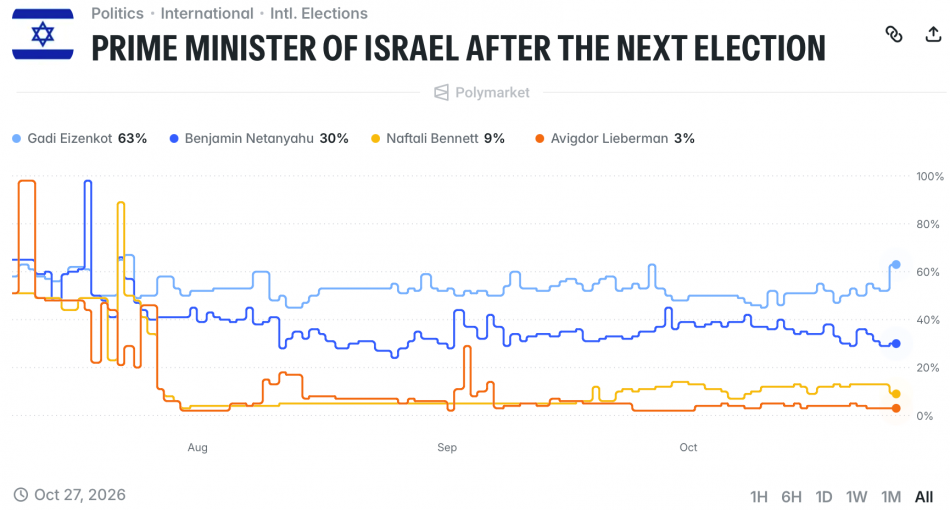
At this stage, Polymarket is giving Eisenkot a 63 percent chance of becoming prime minister…
But there is a huge problem for Eisenkot.
The latest polls show his coalition leading Netanyahu’s coalition, but neither coalition is expected to win enough seats to form a government…
Israel’s final television election polls have delivered a clear but politically complicated verdict: former military chief Gadi Eisenkot’s Yashar party is ahead of Prime Minister Benjamin Netanyahu’s Likud, yet neither the opposition nor Netanyahu’s allies are projected to secure the 61 seats needed to form a government.
The three surveys, published Friday by Kan 11, Channel 12 and Channel 13 ahead of Tuesday’s October 27 election, give the bloc seeking to replace Netanyahu a lead of between two and six seats. With about 7.3 million Israelis eligible to vote, the results point to another potentially difficult round of coalition negotiations, and possibly even another election if no governing majority emerges.
All three networks project Netanyahu’s right-wing and religious bloc winning exactly 50 seats in the 120-member Knesset, while the opposition’s so-called change bloc receives between 52 and 56 seats. The Arab parties, which are not counted as part of either bloc, are projected to win between 14 and 16 seats.
It really doesn’t matter which party finishes first on Tuesday.
What matters is getting to 61 seats.
Netanyahu and Eisenkot have both promised not to include Arab parties as official coalition partners.
So that is likely to make it very difficult for anyone to get to 61 seats.
Once we learn the results of the vote on Tuesday, these are the next steps that will transpire…
Approximately one week after the official results are published, President Isaac Herzog will task a member of the Knesset with forming a government. Herzog can pick whichever member’s proposed coalition he finds most promising — and is not required to choose the member with the largest party or the coalition.
The member has a maximum of seven weeks to convene a ruling coalition before all lawmakers must vote on whether to accept it. That could allow for a minority government and give weaker coalitions a shot at leadership if they can rally the support of the full legislature.
If that member cannot form a coalition able to win majority support in the Knesset, the president appoints another member to form a coalition. If that attempt fails as well, and the Knesset remains gridlocked, the president can dissolve the Knesset, with new elections taking place within 90 days.
Personally, I don’t think that anyone is going to be able to get to 61 seats.
An alternative that is already being discussed is forming a unity government in which Netanyahu and Eisenkot would both take turns as prime minister…
Israeli Prime Minister Benjamin Netanyahu could finish second in Tuesday’s national election behind retired military chief Gadi Eisenkot but still return to lead a unity government alongside the man who vowed to replace him.
That’s a polarizing prospect that Israelis and the Trump administration are contemplating, with polls projecting neither Netanyahu- nor Eisenkot-led blocs will secure the 61 parliamentary seats needed to form a majority government.
Netanyahu and his team realize that this might be Netanyahu’s best shot at remaining prime minister, and so they are “pushing the idea vigorously”…
But Netanyahu’s camp is pushing the idea vigorously and has a sympathetic ear in President Donald Trump, according to three people familiar with the matter who, like many quoted in this article, spoke on the condition of anonymity to discuss sensitive political deliberations.
Of course Eisenkot could choose to reject the formation of a unity government completely.
In that case, Netanyahu could continue to serve as “a caretaker prime minister” until a new election can be held…
If Eisenkot balks at a partnership, Netanyahu also could aim to take advantage of the political gridlock, staying on as a caretaker prime minister and ultimately seeking to force another vote.
There is one other alternative that deserves to be mentioned.
Eisenkot could potentially convince Ra’am to abstain from the confidence vote and form a minority government.
But his allies Avigdor Liberman (Yisrael Beytenu) and Naftali Bennett (Beyachad) have unequivocally ruled out participating in any minority government that relies on Arab parties abstaining.
And so that alternative appears to be very unlikely.
Ultimately, I think that the most likely scenario is that Netanyahu will continue to serve as either a caretaker prime minister or as the first to take a turn as prime minister in a unity government.
Of course the voters in Israel could end up completely surprising us just like the voters in Brazil did.
Speaking of surprises, if the Democrats don’t sweep the midterm elections in the U.S., pollsters will be absolutely stunned.
At this point, nearly all of the pundits on the big news networks are expecting a blue wave.
But those pundits could be wrong.
I am about to show you some numbers that look really good for the Democrats.
But it is important to point out that the numbers looked really good for Bolsonaro before he lost to Lula in Brazil.
We live at a time when anything can happen.
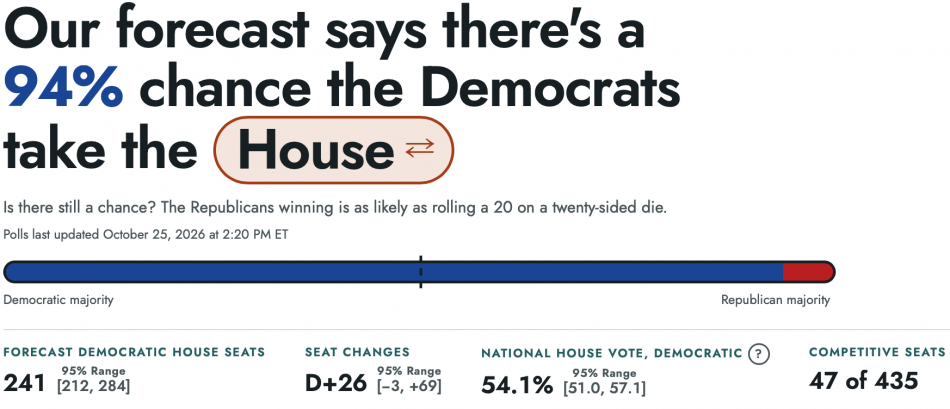
With that being said, Harvard’s computer model is currently projecting that Democrats have a 94 percent chance of taking control of the House of Representatives…
You may think that is a very high figure.
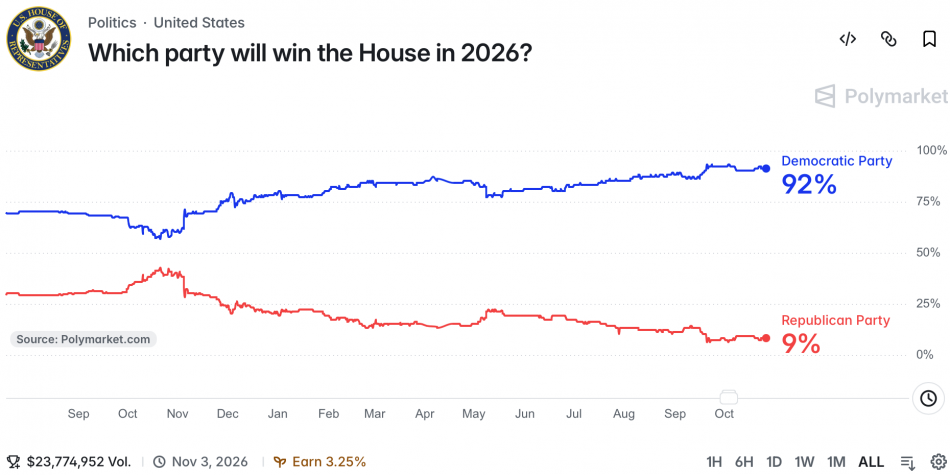
But Polymarket has come up with a similar number…
If the Republicans are able to keep control of the House, it will be a historic shock.
Of course there have been historic shocks before.
2016 is a perfect example.
The race for control of the U.S. Senate is expected to be much closer.
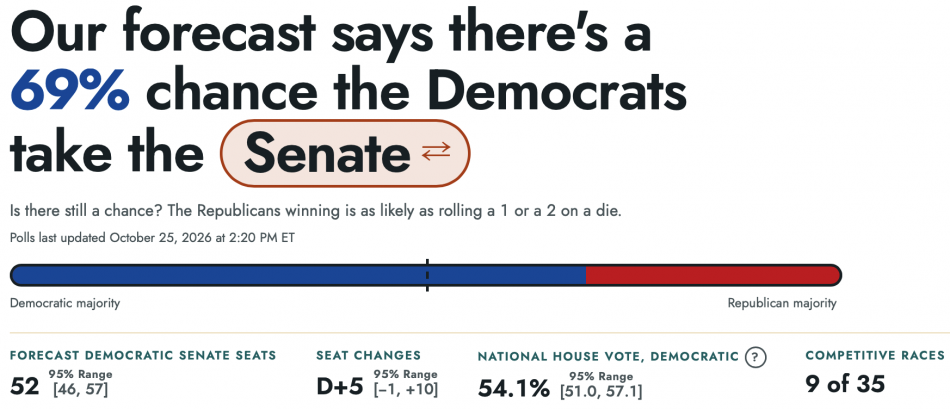
At this stage, Harvard’s computer model is giving the Democrats a 69 percent chance of taking control of the Senate…
That is not good news for the White House.
The Trump administration was really hoping that at least the Senate would remain in Republican hands.
At one time, Polymarket was giving the Republicans more than a 50 percent chance of keeping control of the Senate, but over the past couple of months things have shifted dramatically…
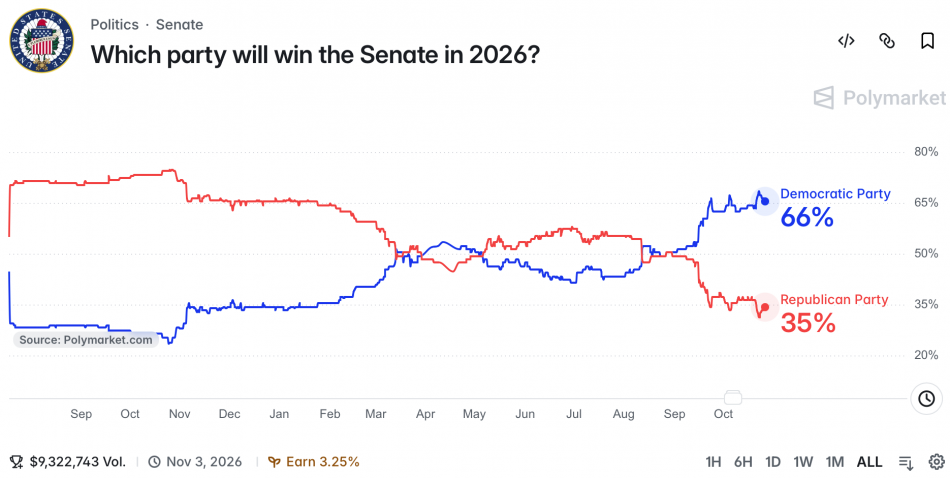
The projections that I have shared do not look good for the Republican Party at all.
But projections do not determine anything.
Ultimately, it is all going to come down to who shows up and actually votes.
Both parties are going to be very focused on turning out their voters in the coming days.
If one party is able to generate significantly more voter enthusiasm than the other party, we could end up seeing some very surprising results on November 3rd.
Michael’s new book entitled “10 Prophetic Events That Are Coming Next” is available in paperback and for the Kindle on Amazon.com, and you can subscribe to his Substack newsletter at michaeltsnyder.substack.com.

About the Author: Michael Snyder’s new book entitled “10 Prophetic Events That Are Coming Next” is available in paperback and for the Kindle on Amazon.com. He has also written nine other books that are available on Amazon.com including “Chaos”, “End Times”, “7 Year Apocalypse”, “Lost Prophecies Of The Future Of America”, “The Beginning Of The End”, and “Living A Life That Really Matters”. When you purchase any of Michael’s books you help to support the work that he is doing. You can also get his articles by email as soon as he publishes them by subscribing to his Substack newsletter. Michael has published thousands of articles on The Economic Collapse Blog, End Of The American Dream and The Most Important News, and he always freely and happily allows others to republish those articles on their own websites. These are such troubled times, and people need hope. John 3:16 tells us about the hope that God has given us through Jesus Christ: “For God so loved the world, that he gave his only begotten Son, that whosoever believeth in him should not perish, but have everlasting life.” If you have not already done so, we strongly urge you to invite Jesus Christ to be your Lord and Savior today.