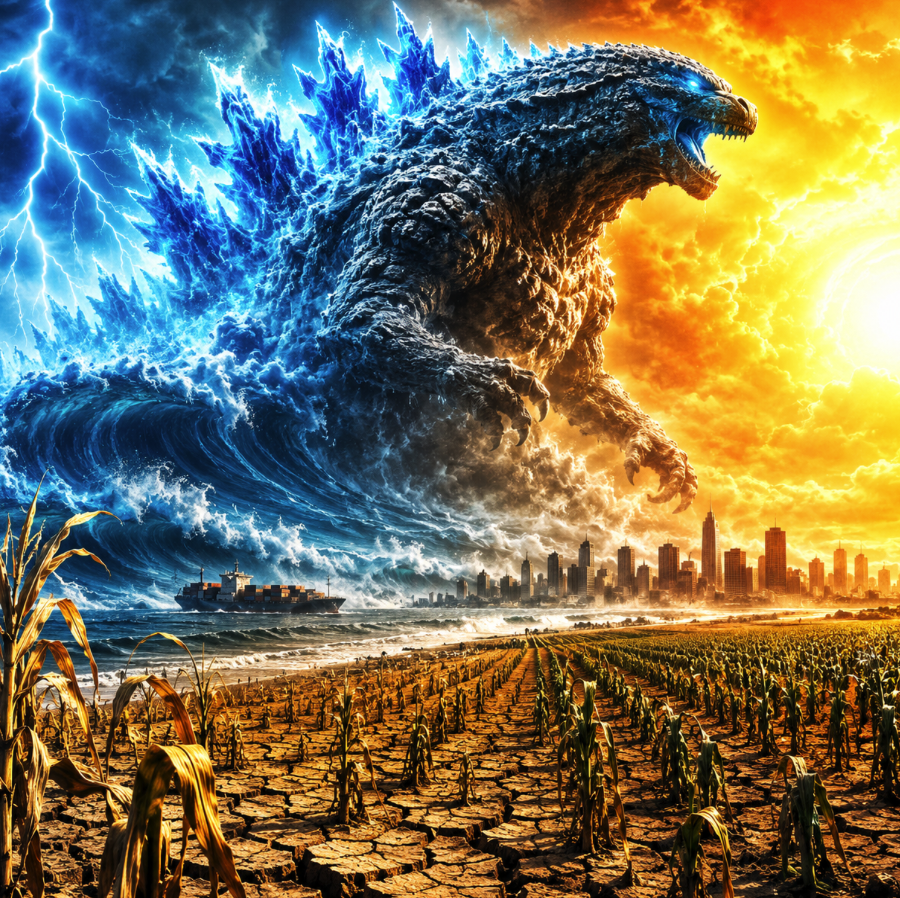
The waters of the Pacific Ocean are getting extremely warm, and that could provide fuel for an immensely destructive climate event that is unlike anything we have ever seen before. Even the United Nations has issued an ominous warning about the El Niño event that is in the long-term forecast, because it will have a dramatic impact on every man, woman and child on the entire planet. We are being told that there is more than an 80 percent chance that El Niño conditions will arrive by the end of next month due to rapidly warming equatorial waters in the Pacific. Meanwhile, an unprecedented “9,000-mile marine heatwave” has developed in the North Pacific. Many experts are concerned that the confluence of those two factors could produce a “Godzilla El Niño”…
The chance of an El Niño event emerging by July is now over 80 percent, which will likely make 2026 one of the hottest years on record. At the same time, an exceptionally large 9,000-mile marine heatwave has been forming in the North Pacific since the end of 2025. These extreme warming events are now evolving together across the Pacific. Scientists are increasingly concerned that the warm water will fuel a “super” or “Godzilla” El Niño, potentially prolonging marine heatwaves, disrupting fisheries and ecosystems, and intensifying global climate impacts well into 2027.
The “9,000-mile marine heatwave” in the North Pacific is absolutely astounding climate scientists.
At the same time, the warming in the equatorial waters where El Niño events normally develop is at a level that we haven’t seen since at least 1877…
The temperature of the ocean in the equatorial waters where these El Niños form was predicted to be 3 degrees Celsius above average. Experts are saying that this is a level of heat in the Pacific Ocean that hasn’t been recorded since 1877.
I have written about the “Super El Niño” that started in 1877 before.
That “Super El Niño” was one of the primary reasons why 50 million people starved during the Great Famine that stretched from 1876 to 1878…
This El Niño, they say, could rival the intense event of the late 19th century that triggered “the Great Famine” on a global scale, killing millions of people. And its scythe sliced through southern Africa.
“The 1876-78 Great Famine impacted multiple regions across the globe, including parts of Asia, Nordeste [Northeast] Brazil, and northern and southern Africa, with total human fatalities exceeding 50 million people, arguably the worst environmental disaster to befall humanity,” a team of scientists said a decade ago in a ground-breaking paper presented at a meeting of the American Geophysical Union.
3 percent of the entire population of the world starved to death during those years.
Today, 3 percent of the entire population of the world would be 240,000,000 people.
In 1982 and 1983, we experienced the most severe “Super El Niño” of the 20th century…
In 1982–83, the most intense El Niño of the 20th century caused extreme weather events throughout the world, including floods in the American Pacific and in the southern United States, and droughts in north-eastern Brazil and Indonesia. It also caused a very mild winter in the mid-latitudes of Europe, Asia and North America.
That “Super El Niño” sparked a horrific famine in eastern Africa that wiped out a very large proportion of the population…
A widespread famine affected Ethiopia from 1983 to 1985.[4] The worst famine to hit the country in a century,[5] it affected 7.75 million people (out of Ethiopia’s 38–40 million) and left approximately 300,000 to 1.2 million dead. 2.5 million people were internally displaced whereas 400,000 refugees left Ethiopia. Almost 200,000 children were orphaned.
Now we are being warned that the most powerful “Super El Niño” of all time could potentially be ahead of us.
We could see insanely hot temperatures all over the world this summer, and we are being told that we are likely to see severe drought conditions “in southern Africa, Australia, India, the Indochina Peninsula and Oceania”…
Easterly trade winds across the equator, meanwhile, are replaced by bursts of westerly surface winds. Those pile warm waters against the western shores of South America. That suppresses cool ocean upwelling from below, which is needed to bring nutrient-rich waters closer to the surface. That starves baitfish and means poor fish harvests for dependent countries in Central America and the Pacific coast of South America.
Drought, meanwhile, is likely in southern Africa, Australia, India, the Indochina Peninsula and Oceania. Southeast Asia, meanwhile, could see above-average rainfall and more flooding.
Here in the United States, we could see a lot less rain than normal in the Midwest, and temperatures in the heartland could be 3 to 6 degrees above normal.
In other words, it would be horrible growing weather.
Our farmers are already facing much higher diesel prices, much higher fertilizer prices and a multi-year drought that never seems to end. Now a “Godzilla El Niño” could be on the way, and the World Meteorological Organization is telling us to brace for the worst…
The World Meteorological Organization is warning that this summer’s El Nino event could be the worst yet. Compounded by fertiliser shortages, inflation and rising oil prices, these shocks threaten to push an already fragile food industry to the brink, and the impact will land squarely in consumers’ shopping baskets.
Coming into this year, the number of people around the world experiencing acute food insecurity was already at the highest level ever recorded.
And now a “Godzilla El Niño” could absolutely devastate food production in many of the areas around the world that grow the four crops that account for 60 percent of all global calories…
Global food security relies heavily on a highly concentrated supply chain. Just four crops, wheat, rice, maize and soybeans, account for over 60% of global calories. While localised regional shortages are typically balanced by other markets, a global El Nino triggers teleconnections: simultaneous weather anomalies across different continents that cause correlated crop failures. And this systemic drop in supply leads to direct price increases at supermarket tills.
In this country, where do we grow most of our wheat, rice, corn and soybeans?
Everyone knows that it is in the heartland, and the heartland of this country is about to get hit by a climate sledgehammer.
Of course we all still have to eat, and so demand for food is not going to go down.
Since there won’t be as much food produced, that means that prices are likely to spike…
Because demand for basic staples is inelastic – consumers must eat regardless of cost – even small supply deficits cause disproportionate price surges. Scenarios for this El Nino indicate price shocks of 10% to 50% across core commodities, with highly exposed crops, including rice, palm oil, sugarcane and coffee, potentially experiencing surges of 50% to 100%, or more.
In the past, price shocks struck one commodity at a time. A simultaneous, cross-category surge means consumers will be hit harder and broader than ever before.
If you think that food prices at your local supermarket are high now, just wait until you see what they are like in the future.
What will struggling American families do if basic staples that they purchase on a regular basis suddenly go up by 50 percent or more?
Of course conditions will be much worse in many impoverished nations around the globe.
In some cases, there simply won’t be nearly enough food to feed everyone.
We really are facing a nightmare scenario, and the vast majority of the global population is completely and utterly unprepared for it.
Michael’s new book entitled “10 Prophetic Events That Are Coming Next” is available in paperback and for the Kindle on Amazon.com, and you can subscribe to his Substack newsletter at michaeltsnyder.substack.com.

About the Author: Michael Snyder’s new book entitled “10 Prophetic Events That Are Coming Next” is available in paperback and for the Kindle on Amazon.com. He has also written nine other books that are available on Amazon.com including “Chaos”, “End Times”, “7 Year Apocalypse”, “Lost Prophecies Of The Future Of America”, “The Beginning Of The End”, and “Living A Life That Really Matters”. When you purchase any of Michael’s books you help to support the work that he is doing. You can also get his articles by email as soon as he publishes them by subscribing to his Substack newsletter. Michael has published thousands of articles on The Economic Collapse Blog, End Of The American Dream and The Most Important News, and he always freely and happily allows others to republish those articles on their own websites. These are such troubled times, and people need hope. John 3:16 tells us about the hope that God has given us through Jesus Christ: “For God so loved the world, that he gave his only begotten Son, that whosoever believeth in him should not perish, but have everlasting life.” If you have not already done so, we strongly urge you to invite Jesus Christ to be your Lord and Savior today.