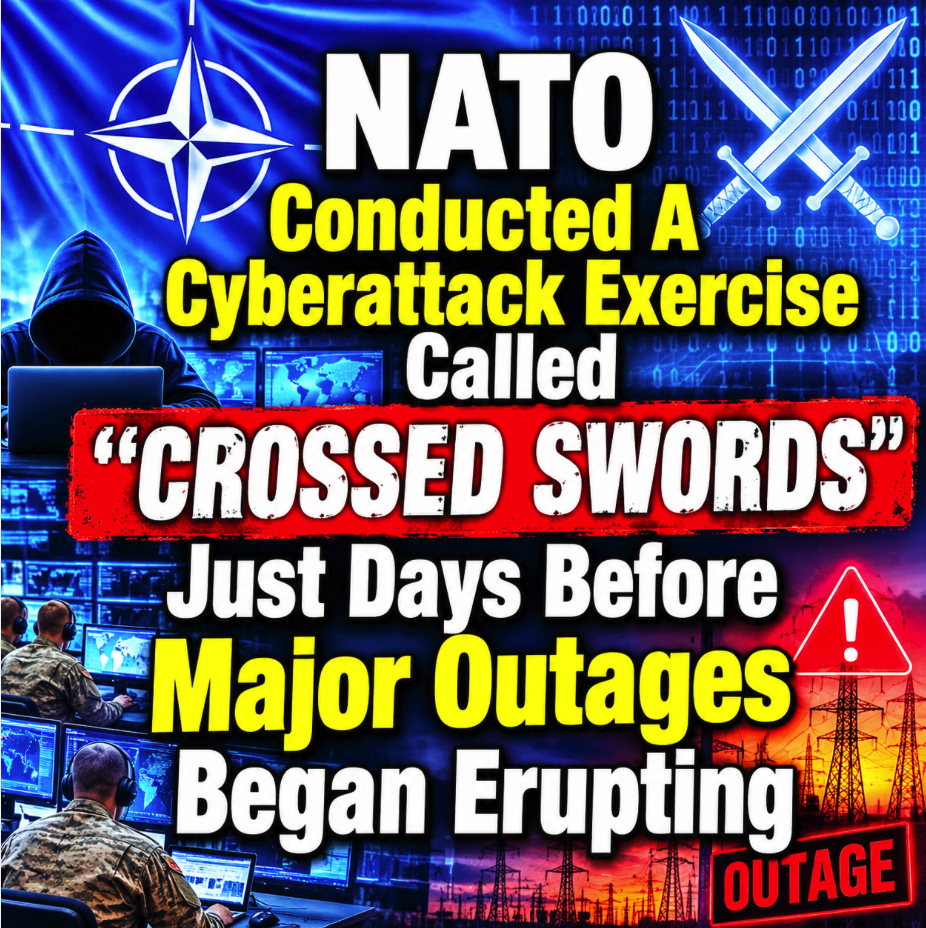
Are we in far more danger than we realize? On November 12th, the longest Microsoft outage in history began, and ever since we have been witnessing one major outage after another. Just 6 days prior to November 12th, NATO completed a major cyberattack exercise known as “Crossed Swords” in Estonia. That exercise ran from November 2nd to November 6th, and it was held in the city of Tallinn. Participants in the exercise constructed, deployed, and evaluated AI agents for cyber operations.
This wasn’t just another NATO exercise.
Over 250 officials from more than 40 different nations participated…
The NATO Cooperative Cyber Defence Centre of Excellence (CCDCOE) has begun the execution phase of Crossed Swords 2026 in Tallinn. Running from 2 to 6 November, the exercise brings together more than 250 participants from over 40 NATO and non-NATO member states to train in cyber operations and their coordination with kinetic activities.
“Crossed Swords gives participants a unique opportunity to prepare for cyber operations in a multi-domain setting. We are seeing growing demand for this kind of training as nations work to strengthen their readiness for increasingly complex operational challenges,” said Tõnis Saar, Director of the NATO CCDCOE.
The exercise is designed to enhance the skills of both operational-level military command elements in managing offensive and defensive cyberspace capabilities and tactical-level cyber specialists. In addition to cyber warfare training, the exercise promotes the development of multi-domain operational competencies and is integrated with a special operations forces exercise.
Of course NATO is not the only one that is scheduling such exercises.
Last month, officials from the G7 “agreed to conduct joint exercises to prepare for AI-enabled cyberattacks targeting the financial sector”…
Finance ministers and central bank governors from the Group of Seven (G7) have agreed to conduct joint exercises to prepare for AI-enabled cyberattacks targeting the financial sector. The decision was confirmed by Japanese Finance Minister Satsuki Katayama following a G7 meeting in Bangkok on 15 October 2026, held alongside the annual meetings of the International Monetary Fund (IMF) and the World Bank.
The planned tabletop exercises will simulate cyber incidents involving advanced AI technologies, allowing G7 financial authorities to assess their ability to respond to potential disruptions. According to Japan’s Finance Ministry, the exercises will test existing emergency procedures, identify weaknesses in coordination and inform revisions to response manuals. Private financial institutions could also participate, depending on the scenarios selected.
The initiative follows discussions among G7 deputy finance ministers about the cybersecurity risks associated with frontier AI models. Katayama said the proposal had received approval at the ministerial level. In its official statement following the Bangkok meeting, the G7 confirmed that finance ministers and central bank governors had discussed the impact of frontier AI on cyber risks in the financial sector and ways to strengthen collective preparedness.
Isn’t that interesting?
Last month they were talking about “cyberattacks targeting the financial sector” and now this month we actually are being hit by “cyberattacks targeting the financial sector”.
In fact, we just learned about another one that affected Visa, Mastercard and JPMorgan Chase…
Data from thousands of Visa, Mastercard and JP Morgan Chase customers was leaked Thursday by a ransomware group, according to several reports.
It’s the latest in a string of tech incidents that have unnerved customers across the U.S. over the past two weeks.
Though the scope and source of the information remain unclear, The Wall Street Journal reports that thousands of customers’ data was involved. The incident has not disrupted payment services and is not linked to banking problems from earlier this week.
Bill Gates was talking about cyberattacks last month too.
He told CNN’s Jake Tapper that “we are going to have a lot of negative surprises” over the next 12 months…
Microsoft co-founder Bill Gates warned Sunday that artificial intelligence could fuel a wave of cyberattacks over the next year, and said that malicious actors are gaining access to increasingly powerful AI models without adequate safeguards.
Gates warned that criminals could exploit the latest AI technology to disrupt financial systems, extort businesses and carry out increasingly sophisticated cyberattacks.
“When you have bad people, no safeguards, and then the latest models, that’s where, over the next year, primarily in the cyber area, we are going to have a lot of negative surprises,” Gates said during a “State of the Union” interview with CNN’s Jake Tapper.
It turns out that Bill Gates was right.
One month later, we are already experiencing “a lot of negative surprises”.
How did he know?
The attacks that we are witnessing are causing a tremendous amount of panic all over the nation.
A 37-year-old IT specialist from Indiana says that the recent attacks have motivated her to become very serious about getting prepared…
Canning fruits was a hobby for Korrie Roth until Microsoft Outlook went down. And then the planes stopped flying. And then Apple Pay froze up. And then the National Security Agency, whose responsibilities include defending the government from cyberattacks, reported its own mysterious outage.
“Now I’m prepping for survival,” said Roth, a 37-year-old IT specialist and mother of five, who lives in Greenwood, Indiana.
No explanation from the country’s leaders has soothed her.
As I discussed earlier this week, we are witnessing the largest wave of panic buying that we have seen in years right now.
A 60-year-old retired aircraft mechanic admitted to the Washington Post that he has spent approximately $3,500 on supplies in just the past month alone…
One 60-year-old retired aircraft mechanic restocked his pantry, adding a solar-based power station to charge electronics, 16 small propane tanks, a large propane tank and a portable heater. In the past month, he estimates he’s spent about $3,500 on additional supplies.
Though Camille Sibert, a 25-year-old stay-at-home mom in Indiana, said she’s been a prepper for three years, the week’s chaos has vindicated her decision to think ahead.
Amid news of the outages, she and her husband went to Walmart and bought canned goods, gallon jugs of water, vitamins and over-the-counter medication. They also filled up their vehicles with gas. “I try to avoid panic buying, but with everything going on in current events we’d rather be safe than sorry,” she said.
All of the outages that we have witnessed so far have been temporary, and no permanent damage has been done.
So if people are this spooked now, what will happen if we actually start experiencing some truly catastrophic cyberattacks?
Of course we are facing a lot of other very serious threats as well.
2026 has been the most chaotic year that we have seen in a long time, and I am entirely convinced that 2027 will be even more chaotic.
I am navigating some deeply intense emotions at this moment. Momentum is building rapidly around events that are only just beginning to take shape, yet the broader significance of what is unfolding seems to be largely unrecognized.
Michael’s new book entitled “10 Prophetic Events That Are Coming Next” is available in paperback and for the Kindle on Amazon.com, and you can subscribe to his Substack newsletter at michaeltsnyder.substack.com.

About the Author: Michael Snyder’s new book entitled “10 Prophetic Events That Are Coming Next” is available in paperback and for the Kindle on Amazon.com. He has also written nine other books that are available on Amazon.com including “Chaos”, “End Times”, “7 Year Apocalypse”, “Lost Prophecies Of The Future Of America”, “The Beginning Of The End”, and “Living A Life That Really Matters”. When you purchase any of Michael’s books you help to support the work that he is doing. You can also get his articles by email as soon as he publishes them by subscribing to his Substack newsletter. Michael has published thousands of articles on The Economic Collapse Blog, End Of The American Dream and The Most Important News, and he always freely and happily allows others to republish those articles on their own websites. These are such troubled times, and people need hope. John 3:16 tells us about the hope that God has given us through Jesus Christ: “For God so loved the world, that he gave his only begotten Son, that whosoever believeth in him should not perish, but have everlasting life.” If you have not already done so, we strongly urge you to invite Jesus Christ to be your Lord and Savior today.