Our culture is being transformed at a pace that is difficult to comprehend. The numbers that I am going to share with you in this article paint an undeniable picture about where our society is heading. That doesn’t mean that the trends that we are witnessing now are permanent. We have been through so many societal pivot points in recent decades, and it is probably inevitable that there will be more. But without a doubt there have been some very clear long-term cultural shifts that have radically changed how we relate to one another and to the world around us.
Earlier today, I came across a survey about how men and women view each other that absolutely shocked me…
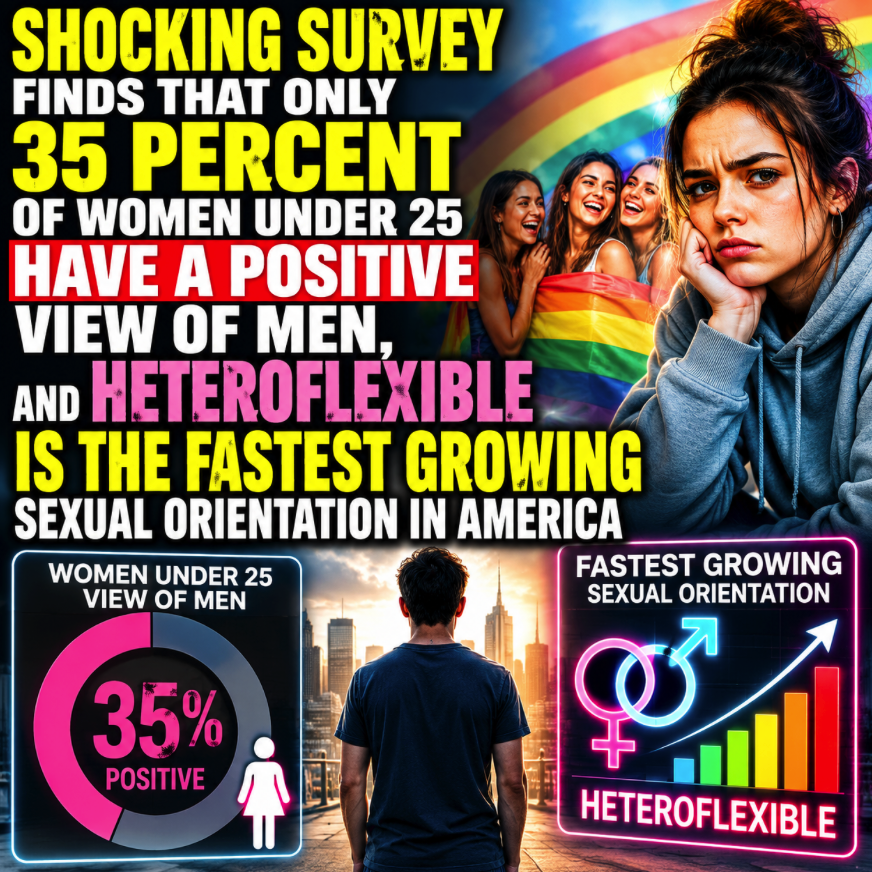
As expected, we found that there are significant divides between young men and young women – but they are not just confined to political views. Gen Z women are more left wing than their male peers when it comes to politics and economics. This generation of women is also much more pessimistic about the country and their own lives than men, and substantially more negative towards men than the men are towards women. Seventy-two per cent of men under 30 say they have a positive view of the opposite gender, compared with just 50 per cent of women of the same age. Thirty-eight per cent of men say they feel “very positively” towards women, while only 18 per cent of women say the same about men. This trend is particularly pronounced among women under 25, of whom just 35 per cent feel positively towards men.
Read that last sentence again.
The survey discovered that only 35 percent of women under the age of 25 have a positive view of men.
How is that even possible?
This survey was conducted in the UK, but I am sure that it would have produced similar results if it had been conducted in the United States.
As I thought about this, it occurred to me that what we are witnessing is likely the result of decades of conditioning.
Men are almost always the villains in our movies and television shows.
When a family is depicted on screen, it is almost always the father that is the problem.
And even in our commercials, men and women are characterized very differently.
Once you become aware of this phenomenon, you will literally see it everywhere.
These days, much of the population considers men (especially young men) to be threats unless proven otherwise, while most women are considered to be trustworthy unless proven otherwise.
Of course it is undeniable that our society is absolutely teeming with criminal predators at this point, and if you trust the wrong person you and your family could get hurt very badly.
The thin veneer of civilization that we all rely on is disintegrating all around us, and that is a terrible thing.
Meanwhile, our values regarding sex and sexuality are rapidly changing.
According to the most recent Gallup poll on the matter, 9 percent of U.S. adults now identify as LGBTQ+…
Gallup finds 9.0% of U.S. adults identifying as lesbian, gay, bisexual, transgender, or something other than straight or heterosexual in 2025. The percentage has more than doubled since Gallup first measured LGBTQ+ identification in 2012.
That is quite a high number, but the real story is what is occurring among our young adults.
According to that same poll, 23 percent of U.S. adults under the age of 30 now identify as LGBTQ+…
Young adults are far more likely than older adults to identify as LGBTQ+. Twenty-three percent of adults under 30 and 10.4% of adults aged 30 to 49 are LGBTQ+, compared with about 2% to 3% of older Americans.
I was curious, and so I had Google create a graph that shows how this number has changed since Gallup began asking this question in 2012.
The results were staggering…
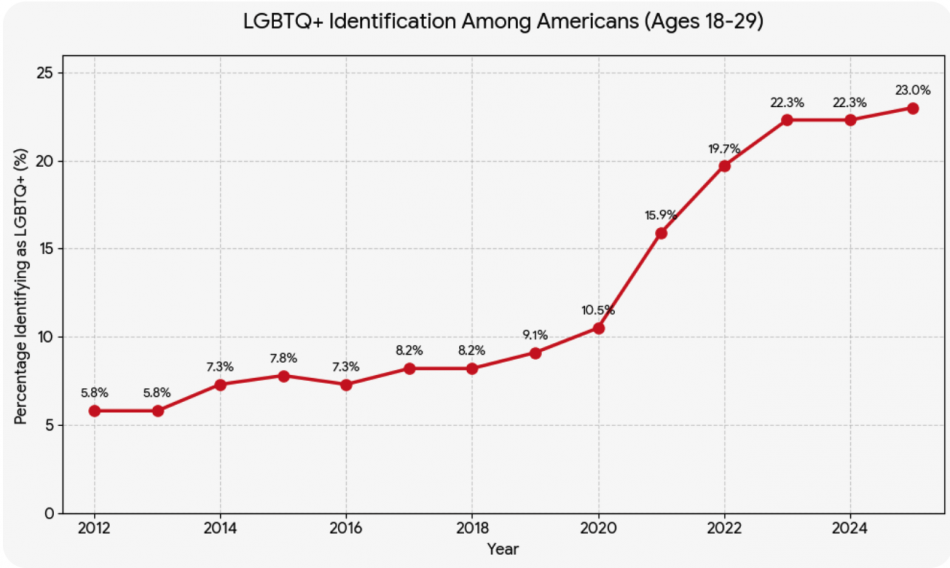
The percentage of U.S. adults under the age of 30 that identify as LGBTQ+ has nearly quadrupled since 2012.
That is not just a trend.
That is a tsunami.
And there is a huge gender gap.
Only 11.4 percent of men under the age of 30 identify as LGBTQ+, but a whopping 31.4 percent of women under the age of 30 do…
Women are nearly twice as likely as men to identify as LGBTQ+ (10.5% vs. 5.6%, respectively), a gap driven primarily by women’s higher rates of bisexual identification. Gender gaps are especially pronounced in the youngest generation — 31.4% of women aged 18 to 29 versus 11.4% of men in the same age group identify as LGBTQ+, with most of these younger women saying they are bisexual.
Nearly a third of all women in the United States under the age of 30 now identify as LGBTQ+.
That may help to explain the survey results that I discussed at the beginning of this article.
And the vast majority of Americans that identify as LGBTQ+ consider themselves to be bisexual…
Bisexual adults make up the largest share of the LGBTQ+ population at 58.6%, equivalent to 5.3% of all U.S. adults. Beyond that, 17.4% of LGBTQ+ adults say they are gay, 16.0% identify as lesbian, and 12.1% say they are transgender, all ranging between 1% and 2% of U.S. adults overall.
This is a point that is often lost when people debate these issues.
Bisexual adults make up the biggest portion of the LGBTQ+ population by a very wide margin.
But now another segment is rapidly growing.
The number of Americans that consider themselves to be “heteroflexible” has been absolutely exploding.
If you are not familiar with “heteroflexibility”, the following explanation comes from Health.com…
Heteroflexibility is a sexual orientation that describes people who are primarily heterosexual but occasionally experience attraction to people of the same sex, according to Debra Laino, DHSc, a clinical sexologist and relationship therapist in Delaware.
People who are mostly attracted to a different gender but also feel some attraction to the same gender fit the definition of heteroflexible.
“Heteroflexible, like most labels, means different things to different people,” Casey Tanner, a clinical sex therapist in Chicago, told Health. “It comes up most of the time when a person identifies as mainly straight with a slight propensity towards queerness in certain circumstances.”
For most of my adult life, I had never even heard of this term.
But according to the New York Post, experts believe that 15 percent of the U.S. population is now “heteroflexible”…
It is estimated that a staggering 15% of the US population — that’s 50 to 55 million Americans — now identifies as heteroflexible.
Those numbers seem high to me.
I have a hard time imagining that there are 50 million “heteroflexibles” out there.
But of course the dating world is far different now than when I was young.
One dating app is actually reporting that the number of their users that identify as “heteroflexible” increased by 193 percent in just one year…
Feeld, a dating app for those seeking alternative relationship structures, recently released its annual Raw report, providing a look at the preferences that shape contemporary intimacy. According to the findings, heteroflexibility is the fastest-growing sexuality, with the number of practitioners skyrocketing by 193% over the past year.
Clearly this is a label that is gaining a tremendous amount of steam.
Nobody can deny that America is a completely different place than it was 50 years ago.
And it would be completely and utterly unrecognizable to our founders.
So much can change in just one generation.
The young adults of today are the future of our society, and that has enormous implications for all of us.
Michael’s new book entitled “10 Prophetic Events That Are Coming Next” is available in paperback and for the Kindle on Amazon.com, and you can subscribe to his Substack newsletter at michaeltsnyder.substack.com.

About the Author: Michael Snyder’s new book entitled “10 Prophetic Events That Are Coming Next” is available in paperback and for the Kindle on Amazon.com. He has also written nine other books that are available on Amazon.com including “Chaos”, “End Times”, “7 Year Apocalypse”, “Lost Prophecies Of The Future Of America”, “The Beginning Of The End”, and “Living A Life That Really Matters”. When you purchase any of Michael’s books you help to support the work that he is doing. You can also get his articles by email as soon as he publishes them by subscribing to his Substack newsletter. Michael has published thousands of articles on The Economic Collapse Blog, End Of The American Dream and The Most Important News, and he always freely and happily allows others to republish those articles on their own websites. These are such troubled times, and people need hope. John 3:16 tells us about the hope that God has given us through Jesus Christ: “For God so loved the world, that he gave his only begotten Son, that whosoever believeth in him should not perish, but have everlasting life.” If you have not already done so, we strongly urge you to invite Jesus Christ to be your Lord and Savior today.