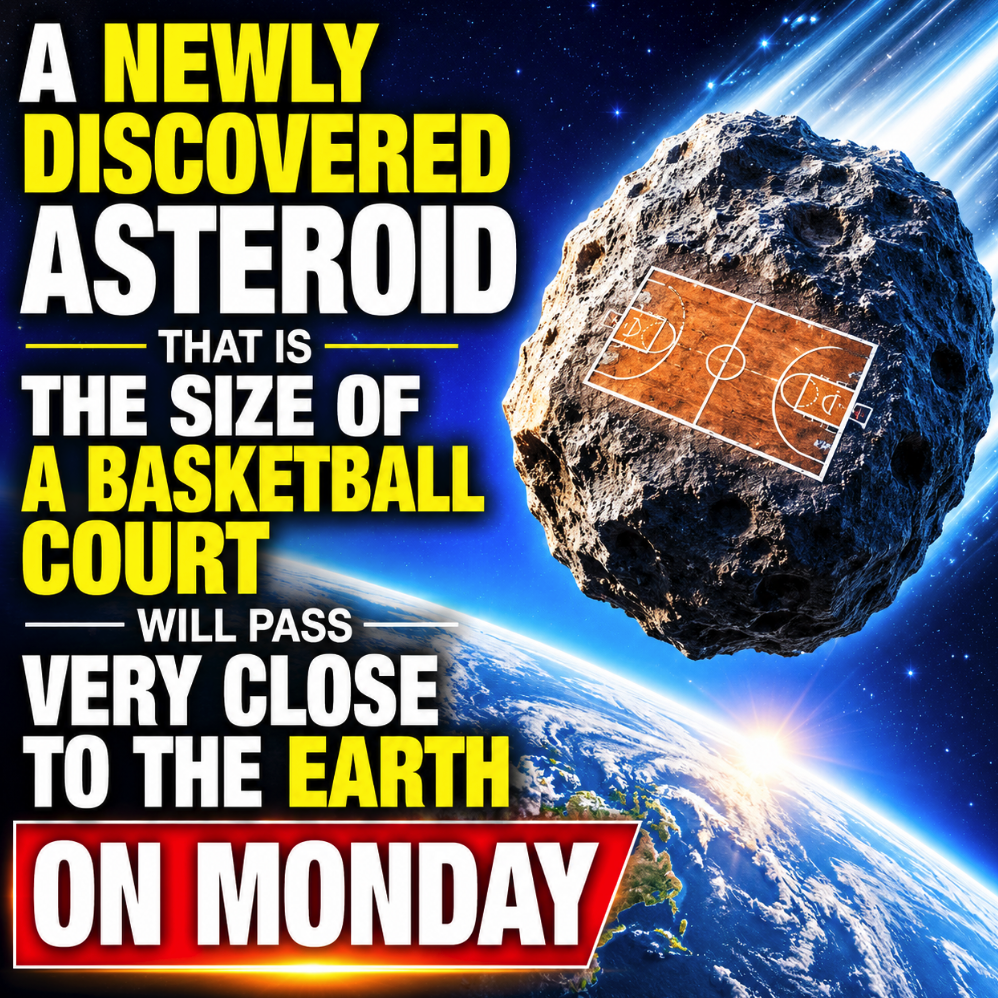
A really big space rock is going to have a very close encounter with our planet on Monday. Based on current calculations, we are being told that we don’t have anything to be concerned about, but if this really big space rock actually hit a major city it would cause a catastrophic amount of damage. So let’s hope that what the astronomers are telling us is correct.
Of course this is not the only asteroid that has come uncomfortably close to Earth in 2026.
So far this year, a whopping 72 asteroids have flown past our planet at a distance of less than 1 lunar distance.
In other words, the level of traffic in our particular neighborhood has risen to a very alarming level.
In fact, on May 7th an asteroid that was only discovered the day after it flew by us came within 0.114 lunar distances of the center of our planet…
Asteroid 2026 JM2 passed Earth at a distance of 0.114 LD (0.00029 AU / 43 800 km / 27 200 miles), from the center of our planet at 13:06 UTC on May 7, 2026, becoming the 4th closest known asteroid flyby within 1 lunar distance recorded so far this year. At its closest, the object was about 37 400 km (23 200 miles) above Earth’s surface, about 1 600 km (1 000 miles) outside the altitude used by geostationary satellites.
2026 JM2 is one of 72 known asteroids to pass within 1 lunar distance of Earth in 2026 and the 4th closest so far this year, following 2026 EM, which passed at 0.072 LD on March 7; 2026 HZ4, which passed at 0.077 LD on April 24; and 2026 DN5, which passed at 0.112 LD on February 22.
The object was first observed at JPL SynTrack Robotic Telescope, Auberry, at 07:02 UTC on May 8 — about 17 hours 56 minutes after closest approach.
That asteroid could have easily entered our atmosphere, and we never even saw it coming.
Now another one is rapidly approaching, and it is big.
According to the BBC, the asteroid that will come zipping past us on Monday is “about as big as a basketball court”…
An asteroid about as big as a basketball court is due to swing close to Earth this Monday, and will pass well within the orbit of the Moon.
Why isn’t this getting more attention from the mainstream media?
Apparently this very large space rock has “enough mass to wipe out a city”…
Despite having enough mass to wipe out a city it was only identified by observatories a few days ago, raising concerns about the early detection of potentially hazardous asteroids.
The reason why most of us are just learning about this asteroid now is because it was just discovered.
It was initially seen by the Mt. Lemmon Survey that is located near Tucson, Arizona on May 10th.
We are actually quite fortunate that this one was spotted in advance, because many near-Earth objects are only discovered once they have already flown past our planet.
It is being estimated that this asteroid is somewhere between 50 and 115 feet wide…
The Small-Body Database led by NASA’s Jet Propulsion Laboratory suggests 2026 JH2 measures somewhere between 16–35 metres (50–115 feet) wide.
For comparison, the Chelyabinsk meteor that entered the atmosphere over Russia in 2013 was about 20 metres (65 feet) wide.
If the Chelyabinsk meteor had exploded over a heavily populated area, a massive amount of damage would have been done.
According to Wikipedia, the explosion of that meteor produced “approximately 30 times as much energy as that released by the atomic bomb detonated at Hiroshima”…
The object exploded in a meteor air burst over Chelyabinsk Oblast, at a height of about 30 kilometres (18.6 miles).[6] The explosion generated a bright flash, producing a hot cloud of dust and gas that penetrated to 26 kilometres (16 mi), and many surviving small fragmentary meteorites. Most of the object’s energy was absorbed by the atmosphere, creating a large shock wave. The asteroid had a total kinetic energy before atmospheric impact equivalent to the blast yield of 400–500 kilotonnes of TNT (1.7–2.1 petajoules), estimated from infrasound and seismic measurements. This was approximately 30 times as much energy as that released by the atomic bomb detonated at Hiroshima.[7]
The object approached Earth undetected before its atmospheric entry, in part because its radiant (source direction) was close to the Sun. 1,491 people were injured seriously enough to seek medical treatment. All of the injuries were due to indirect effects rather than the meteor itself, mainly from broken glass from windows that were blown in when the shock wave arrived, minutes after the superbolide’s flash. Around 7,200 buildings in six cities across the region were damaged by the explosion’s shock wave, and authorities scrambled to help repair the structures in sub-freezing temperatures. No deaths were reported.
Now we are going to have a very close encounter with a space rock that could be even bigger.
One scientist is claiming that this asteroid will come “as close as you can get without hitting”…
2026JH2, as it has been labelled by the astronomy community, is predicted to zoom by our planet at an estimated distance of 90,917 kilometres – only a quarter of the distance between us and the moon.
“In astronomical terms, it’s as close as you can get without hitting,” says Mark Norris at the University of Lancashire, UK.
If an asteroid comes too close, it can be pulled into our atmosphere by the Earth’s gravity.
So let us hope that the calculations that our astronomers have come up with are correct and that it will safely pass us at a distance of approximately 56,000 miles on Monday…
Asteroid 2026 JH2’s closest approach to Earth is expected at 21:23 UTC on 18 May 2026, when it will pass by at a distance of 90,000km (56,000 miles).
That may sound incredibly far away – and it is – but to put it into perspective, the average distance between Earth and the Moon is 385,000km (239,000 miles)
That means asteroid 2026 JH2 will pass Earth at just under a quarter of the distance between Earth and the Moon.
If our astronomers are wrong and this thing actually hits us, it would be a very serious event.
One expert is warning that this asteroid is so large that it “would ruin a city quite efficiently”…
‘It’s the kind of thing that would ruin a city quite efficiently, if it hit,’ Mark Norris, from the University of Lancashire, told New Scientist.
The good news is that scientists are telling us that “current calculations show no impact risk”…
Astronomers are still working to better understand the asteroid’s orbit and physical characteristics. So far, the object has been tracked only 24 times over several days. While its trajectory is still being refined, current calculations show no impact risk.
Even if this particular asteroid is no threat, astronomers openly admit that there are thousands upon thousands of other near-Earth objects that still haven’t been discovered yet.
One of these days, it is inevitable that time will run out and an extremely large space rock will hit our planet.
When that day arrives, it will dramatically alter the course of human history.
So let’s keep watching the skies.
Even now a monstrous near-Earth object could be heading our way, and our scientists may only discover it a short time before impact.
Michael’s new book entitled “10 Prophetic Events That Are Coming Next” is available in paperback and for the Kindle on Amazon.com, and you can subscribe to his Substack newsletter at michaeltsnyder.substack.com.

About the Author: Michael Snyder’s new book entitled “10 Prophetic Events That Are Coming Next” is available in paperback and for the Kindle on Amazon.com. He has also written nine other books that are available on Amazon.com including “Chaos”, “End Times”, “7 Year Apocalypse”, “Lost Prophecies Of The Future Of America”, “The Beginning Of The End”, and “Living A Life That Really Matters”. When you purchase any of Michael’s books you help to support the work that he is doing. You can also get his articles by email as soon as he publishes them by subscribing to his Substack newsletter. Michael has published thousands of articles on The Economic Collapse Blog, End Of The American Dream and The Most Important News, and he always freely and happily allows others to republish those articles on their own websites. These are such troubled times, and people need hope. John 3:16 tells us about the hope that God has given us through Jesus Christ: “For God so loved the world, that he gave his only begotten Son, that whosoever believeth in him should not perish, but have everlasting life.” If you have not already done so, we strongly urge you to invite Jesus Christ to be your Lord and Savior today.