This is the worst of times for U.S. farmers. Coming into 2026, we were already in the midst of the worst farming crisis in at least 50 years. Now the war in the Middle East has caused fertilizer prices to go absolutely haywire, and a historic drought has created nightmare conditions for farmers from coast to coast. What we are witnessing is truly unprecedented. One recent survey discovered that 70 percent of U.S. farmers won’t be able to afford all of the fertilizer that they need this year. When have we ever seen that happen before? And some farmers are telling us that they may not plant anything at all this year due to extreme drought. If the information in this article shocks you, that is good, because we all need a major league wake up call right now.
The Strait of Hormuz is the most important chokepoint on the entire planet, and as I write this article there are hundreds of commercial vessels on both sides of the Strait that are unable to travel through it…
Hundreds of commercial tankers are stranded on both sides of the Strait of Hormuz after Iran shut the critical chokepoint on April 18, halting traffic and leaving crews trapped amid reports of gunfire and “traumatic experiences” on board.
The Strait of Hormuz is considered an international waterway under international law, through which ships have the right of transit passage, according to the United Nations Convention on the Law of the Sea (UNCLOS).
Approximately one-third of all globally-traded nitrogen fertilizer normally travels through the Strait of Hormuz, and nations all over the globe use natural gas that is exported through the Strait of Hormuz to make their own nitrogen fertilizer.
So the fact that the Strait of Hormuz is closed is a really big deal, because without sufficient quantities of nitrogen fertilizer we do not have any hope of feeding the entire planet…
The connection is simple, agricultural fact, not speculation: reduced fertilizer application directly translates to plummeting crop yields. Modern industrial agriculture is utterly dependent on synthetic nitrogen, a product of the Haber-Bosch process which itself requires immense amounts of natural gas [3]. With the Strait of Hormuz closed and LNG infrastructure attacked, the feedstock for this process is becoming scarce and prohibitively expensive. As one analysis starkly put it, half the world’s nitrogen supply is now compromised, threatening global agriculture [4]. This isn’t a theory; it’s chemistry and logistics.
The coming scarcity will not manifest as a gradual, manageable price increase. It will be a sudden, severe shortage hitting supermarket shelves. The system has no slack. As farmers face soaring costs for diesel and natural gas, many are reducing planting or cutting back on fertilizer application, which threatens global grain yields [5]. The recent failure of a critical Australian ammonia plant, exacerbating the global crisis, is just one more domino falling [6]. We are witnessing a cascading failure.
This crisis exposes the fatal fragility of our centralized, just-in-time food system, built for corporate efficiency but not for human resilience. It is a house of cards. As noted in studies of agricultural systems, when trade collapses and scarcity of inputs occurs, yields fall drastically [7]. Our entire civilization is balanced on this vulnerable, centralized point of failure. The system is designed to move commodities for profit, not to ensure communities are fed. When the just-in-time model fails, it fails completely, leaving nothing in the pipeline.
Since the war with Iran began, fertilizer prices have been going parabolic.
I shared a chart that proves this last week, and I am going to share it again today…
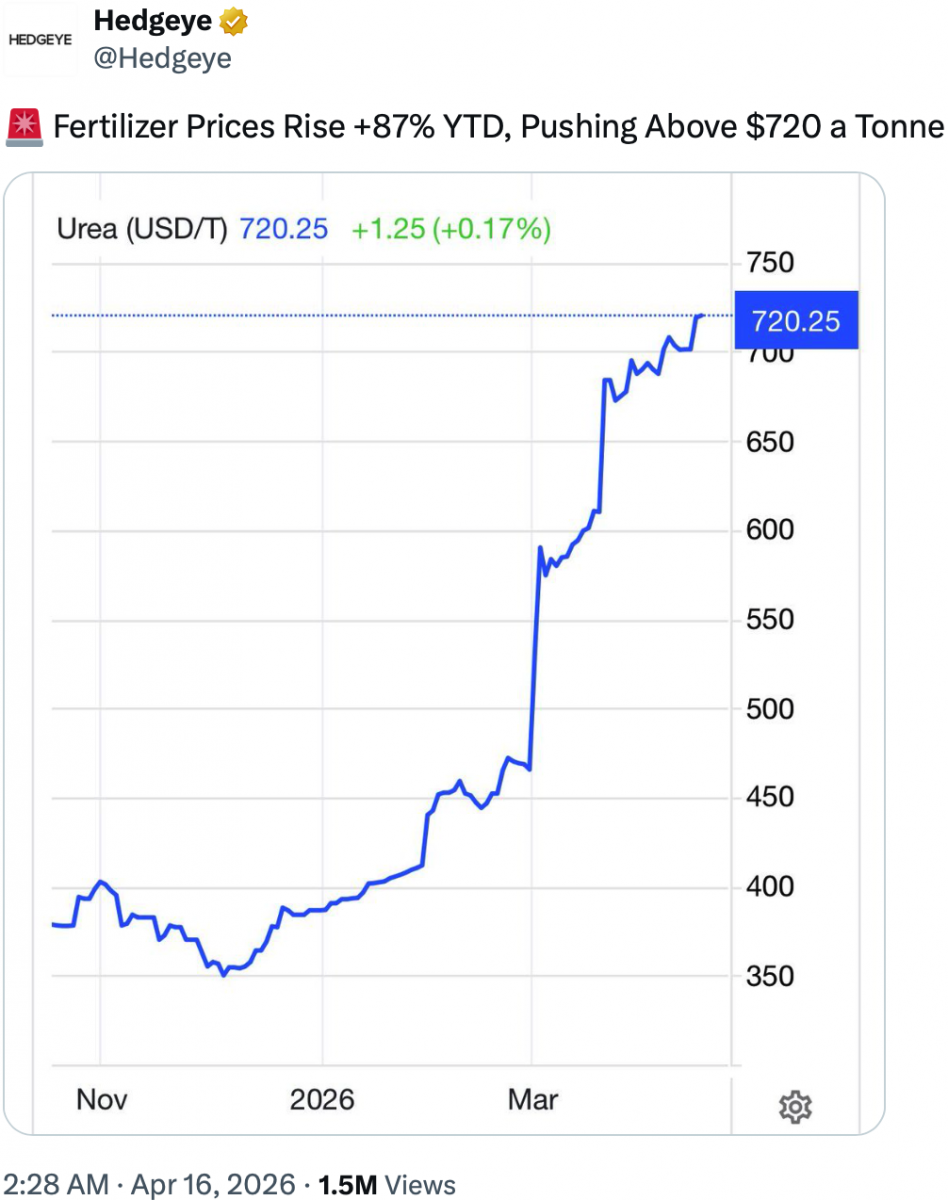
Needless to say, rising fertilizer costs are going to get passed along to consumers.
That means that all of us are going to be paying significantly higher prices at the grocery store in the months ahead…
Americans worried about grocery prices may soon feel the consequences of an unexpected problem on U.S. farms caused by the war in Iran – rising fertilizer prices are creating a potential ripple effect that could reach grocery stores.
Why? The American Farm Bureau Federation cited the virtual closing of the Strait of Hormuz as the main reason fertilizer prices are increasing . Roughly one-third of global seaborne fertilizer trade passes through the strait, according to the United Nations.
At least 70% of farmers say they can’t afford all the fertilizer they need because of higher costs tied to the Iran war − a challenge that could lower crop yields, which, if widespread enough, could push food prices upward.
Unfortunately, U.S. farmers are facing another enormous crisis in addition to absurdly high fertilizer prices.
I have written quite a bit about the horrendous drought that is currently plaguing much of the nation.
If you can believe it, over 61 percent of the U.S. is currently experiencing at least some level of drought…
With drought stretching from coast to coast, water restrictions are already in effect in many states even before the thirsty summer season begins. Indeed, more than 61% of the nation is now in a drought, the highest percentage in nearly four years, according to the most recent U.S. Drought Monitor.
In all, 45 of 50 states are enduring drought, with only Alaska, North Dakota, Michigan, Connecticut and Rhode Island completely drought-free.
We are only in late April.
So what will conditions be like once we reach July and August?
In Colorado, the entire state is currently experiencing at least some level of drought, and this is “pummeling Colorado farmers”…
This year’s record-warm, dry spring is pummeling Colorado farmers amid multiple threats, disrupting the state’s $9 billion agricultural sector and jeopardizing even signature crops such as Pueblo green chiles, Olathe sweet corn and Palisade peaches.
Water scarcity, due to exceptionally low mountain snow and soil-drying heat, looms foremost.
To say that farmers in Colorado desperately need rain would be a massive understatement.
One farmer that was recently interviewed by a local news outlet openly admitted that if it doesn’t start raining soon he isn’t going to plant anything at all this year…
“If we don’t get moisture, I’m not going to plant,” said chile grower Praxie Vigil, who runs Vigil Farms along the Bessemer Ditch, a 43-mile irrigation canal that once nourished crops across 20,000 acres east of Pueblo. He was planning to decide this weekend.
“It’s not looking good for any of us. Usually, I just plant and hope for the best. But this year, I’m not going to. This is bad. I can barely water 20 acres,” said Vigil, who works a side job as a pipe-welder to make ends meet.
Farmers all over America are facing some very difficult choices in 2026.
Of course the same thing could be said about farmers all over the world.
Global weather patterns have been going absolutely nuts, and now the worst fertilizer crisis in history is upon us.
At this moment we are still eating food that was grown last year.
But six to nine months from now, a global food shock is going to hit us like a freight train.
We should certainly hope for the best, but it would also be wise to prepare for the worst.
Michael’s new book entitled “10 Prophetic Events That Are Coming Next” is available in paperback and for the Kindle on Amazon.com, and you can subscribe to his Substack newsletter at michaeltsnyder.substack.com.

About the Author: Michael Snyder’s new book entitled “10 Prophetic Events That Are Coming Next” is available in paperback and for the Kindle on Amazon.com. He has also written nine other books that are available on Amazon.com including “Chaos”, “End Times”, “7 Year Apocalypse”, “Lost Prophecies Of The Future Of America”, “The Beginning Of The End”, and “Living A Life That Really Matters”. When you purchase any of Michael’s books you help to support the work that he is doing. You can also get his articles by email as soon as he publishes them by subscribing to his Substack newsletter. Michael has published thousands of articles on The Economic Collapse Blog, End Of The American Dream and The Most Important News, and he always freely and happily allows others to republish those articles on their own websites. These are such troubled times, and people need hope. John 3:16 tells us about the hope that God has given us through Jesus Christ: “For God so loved the world, that he gave his only begotten Son, that whosoever believeth in him should not perish, but have everlasting life.” If you have not already done so, we strongly urge you to invite Jesus Christ to be your Lord and Savior today.