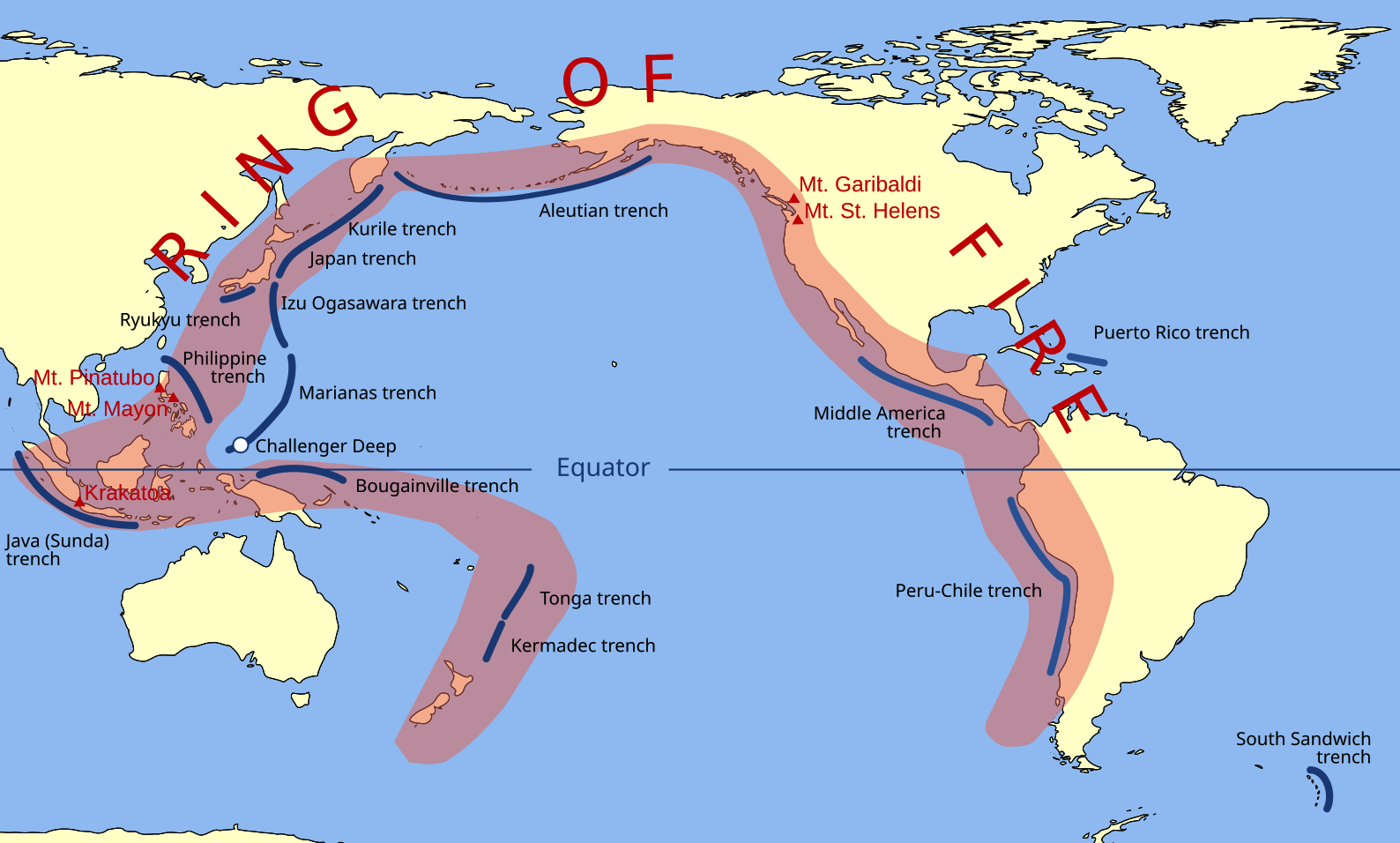
Should we be alarmed that there has been so much activity along the Pacific Ring of Fire lately? Every time that there is another major event, and that has been occurring quite frequently in recent weeks, the experts rush to tell us that what we are witnessing is perfectly normal. But is that really true? Late last month, I wrote an article about how volcanoes that have been dormant for ages are suddenly roaring to life all over the globe. I don’t understand how it is “perfectly normal” for multiple volcanoes that have been dormant for hundreds or even thousands of years to all be waking up at the same time. I just don’t see it. Similarly, I don’t understand how it is “perfectly normal” for so much shaking to be taking place all along the Ring of Fire right now.
For example, on Monday a magnitude 7.6 earthquake rattled northern Japan…
A powerful 7.6-magnitude earthquake shook northeastern Japan late on Monday, prompting tsunami warnings and orders for about 90,000 residents to evacuate.
The Japan Meteorological Agency said a tsunami as high as 3 metres (10 feet) could hit Japan’s northeastern coast after the earthquake struck off the coast at 11:15 p.m. (1415 GMT).
Tsunami warnings were issued for the prefectures of Hokkaido, Aomori and Iwate, and tsunamis from 20 to 70 cm (7 to 27 inches) high were observed at several ports, JMA said.
A magnitude 7.6 earthquake is quite powerful.
The Daily Mail is reporting that buildings and vehicles were “trembling as the ground beneath them shook violently”…
Video footage showed buildings and stationary vehicles trembling as the ground beneath them shook violently.
Another clip showed a terrified man in his home watching lights bounce around amid the earthquake, while a third showed a siren being sounded, warning citizens of the imminent danger.
If this was just an isolated incident, we could probably safely ignore it.
But the truth is that Japan has been hit by a number of severe earthquake swarms in 2025, and that includes a massive swarm of 1,198 earthquakes that stretched from late June to early July…
From June 25 to July 4, a total of 1,198 earthquakes occurred near the Tokara Islands in far southwest Japan. The largest of these, on July 4, was at the lower end of 6 on the Japan Meteorological Agency seismic intensity scale (JMA scale).[22] This earthquake swarm was the most intense in the region since 1995.[23] 31 residents requested evacuation to Mainland Japan following several earthquakes of 5+ on the JMA scale, i.e. approximately VII on the Mercalli scale[b][25][26]
I certainly don’t think that was normal.
At the end of July, a magnitude 8.8 megathrust earthquake struck the Pacific Ring of Fire just off the coast of the Kamchatka Peninsula…
On 30 July 2025, at 11:24:52 PETT (29 July, 23:24:52 UTC), a Mw 8.8 megathrust earthquake struck off the eastern coast of the Kamchatka Peninsula in the Russian Far East, 119 km (74 mi) east-southeast of the coastal city of Petropavlovsk-Kamchatsky.[3][4] It was the most powerful earthquake recorded worldwide since the 2011 Tōhoku earthquake,[5] and is tied with the 1906 Ecuador–Colombia and 2010 Chile earthquakes as the sixth-strongest ever recorded by seismometers.[6]
That quake was part of a global swarm of 494 earthquakes of magnitude 5.0 or greater within a 30 day period.
That was about 4 times as many earthquakes of magnitude 5.0 or greater than we usually experience in a typical month.
Nobody can claim that was normal.
Here in the United States, the west coast has been getting pummeled by earthquake swarms over and over again.
In fact, there was another earthquake swarm in California on Monday…
A swarm of earthquakes has struck California’s Bay Area, just miles from some of the most populated cities throughout the area.
A magnitude 3.7 earthquake was detected at 12.08pm ET on Monday, less than three miles from the city of San Ramon, followed by a magnitude 2.9 quake at 1.06pm.
The US Geological Survey (USGS) has revealed that these were at least the sixth and seventh small earthquake to strike the since 5.33am this morning.
The quakes took place less than 40 miles from San Francisco, and less than 30 miles from major cities such as Oakland, Concord, and San Jose.
One earthquake swarm in California is not a big deal.
But there were three other earthquake swarms in California just last week…
Monday’s swarm was the latest seismic outbreak in the Bay Area, coming just days after residents in the region were shaken by three straight days of earthquake swarms rattling nerves along the state’s Central and Northern Coasts.
The recent swarms have also taken place along several branch faults in the broader San Andreas Fault System, sparking fears the main fault line could be closer to a major rupture that locals refer to as ‘the Big One.’
I have written a lot about “the Big One”.
It is coming.
And it is going to be a lot more destructive than the experts are admitting.
Have you seen the movie San Andreas?
When “the Big One” finally hits, it is going to be far worse than that.
If you live in Alaska, you are in danger too.
On Saturday, the state was rattled by a magnitude 7.0 earthquake…
According to the United States Geological Survey (USGS), a magnitude 7.0 earthquake struck Alaska during the morning hours Saturday.
The earthquake struck at 11:41 a.m. local time northeast of Yakutat, Alaska, per the USGS.
The U.S. Census Bureau reports that Yakutat had a population of approximately 657 in 2020, and in 2023, a total of 332 housing units. The USGS interactive map indicates that the community lies more than 300 miles from Anchorage, where the quake was also experienced.
That quake was the first in a series of 164 quakes that rattled the state in less than 24 hours…
Residents as far away as Anchorage and communities across the border in Canada’s Yukon Territory reported feeling the quake.
In the 24 hours following the main quake, seismic networks logged 164 earthquakes in the region. Many were aftershocks, including several registering magnitudes above 5.0. This number of aftershocks is not uncommon after a significant seismic event as the crust readjusts along the fault lines.
The entire southern coastline of Alaska sits directly along the Pacific Ring of Fire.
So does the entire west coast of the United States.
If you choose to live in one of those danger zones, you are taking a huge risk.
We are getting more warning signs on an almost daily basis, but most of those that live in high risk areas will ignore the warning signs until it is too late.
Michael’s new book entitled “10 Prophetic Events That Are Coming Next” is available in paperback and for the Kindle on Amazon.com, and you can subscribe to his Substack newsletter at michaeltsnyder.substack.com.

About the Author: Michael Snyder’s new book entitled “10 Prophetic Events That Are Coming Next” is available in paperback and for the Kindle on Amazon.com. He has also written nine other books that are available on Amazon.com including “Chaos”, “End Times”, “7 Year Apocalypse”, “Lost Prophecies Of The Future Of America”, “The Beginning Of The End”, and “Living A Life That Really Matters”. When you purchase any of Michael’s books you help to support the work that he is doing. You can also get his articles by email as soon as he publishes them by subscribing to his Substack newsletter. Michael has published thousands of articles on The Economic Collapse Blog, End Of The American Dream and The Most Important News, and he always freely and happily allows others to republish those articles on their own websites. These are such troubled times, and people need hope. John 3:16 tells us about the hope that God has given us through Jesus Christ: “For God so loved the world, that he gave his only begotten Son, that whosoever believeth in him should not perish, but have everlasting life.” If you have not already done so, we strongly urge you to invite Jesus Christ to be your Lord and Savior today.